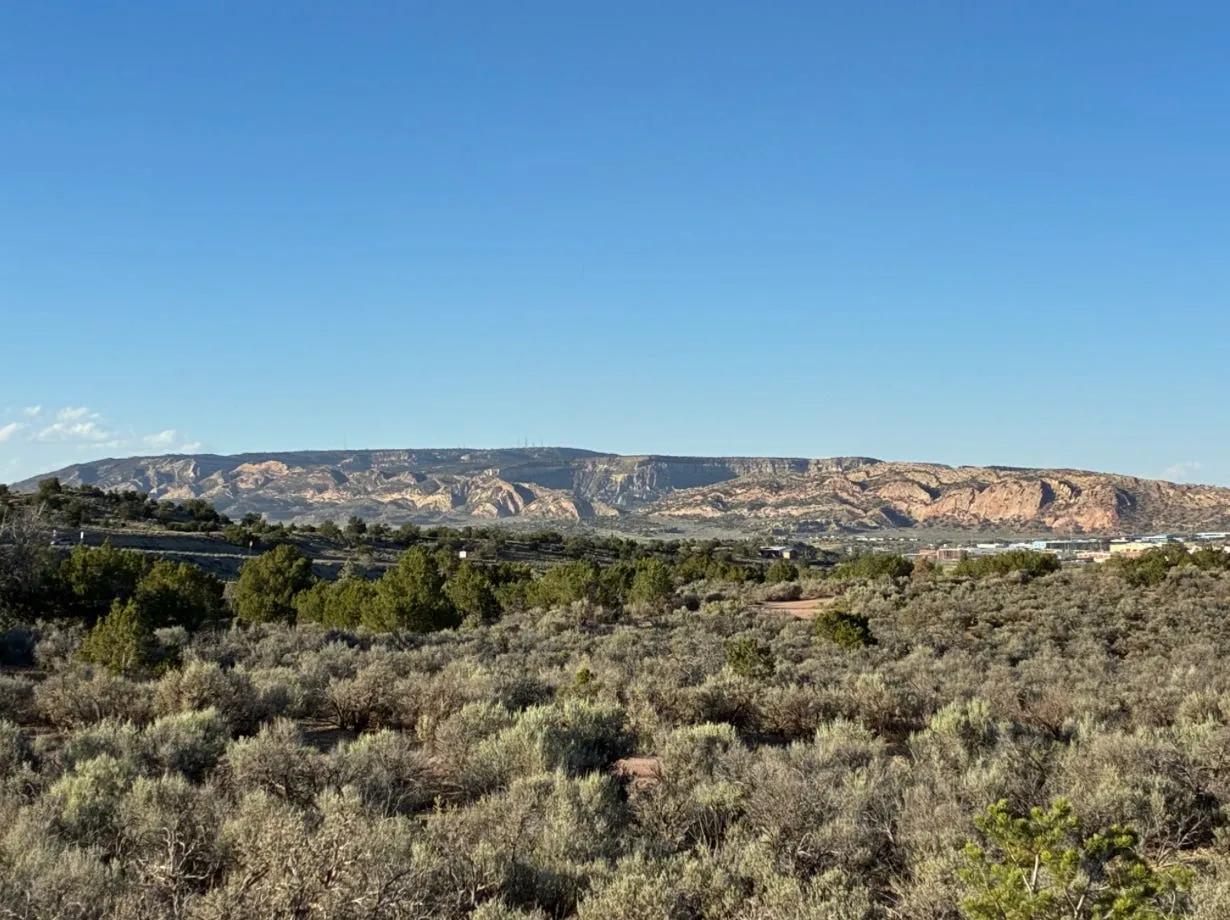
The Gallup Lion’s Club Rodeo took place over the course of a long sunset in a bowl of red rock out south of Gallup proper. The natural rock faces cradle a sand-pit arena with bleachers enough to host everyone in town, plus visitors. Behind the arena sat trailers, horses looking out of the slats with oil-dark eyes. I couldn’t tell if they were nervous, or if this was just routine.
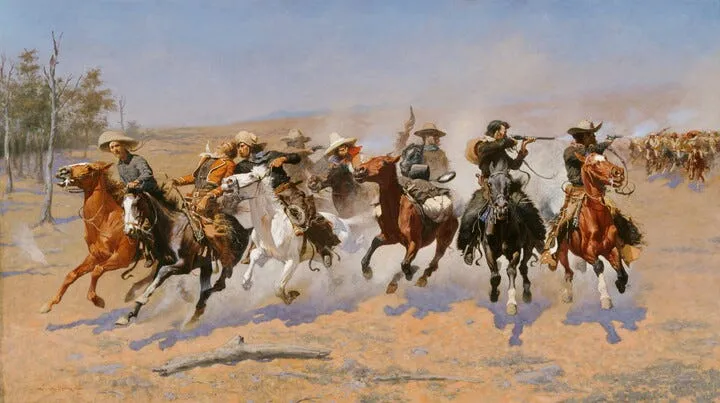
Frederic Remington
All of us gathered at the arena to watch steer roping, barrel racing, and of course, bull-riding. Nobody managed to stay on the bulls for long, but that was less due to lack of skill than to how difficult bull-riding is. Even the best bull rides are short - a rider must stay on the bull for 8 seconds or else receives no score. Only one bull rider in history has achieved a perfect 100 point score in bull riding - Wade Leslie, for his 1991 ride on Wolfman. All the bulls have names like this - Frankenstomp, Buck Nasty, Ransom, Nobody, Electric Kitty, Constant Payne, I Hate You. They earn their names, throwing men off their broad backs within a few seconds and trampling them with intent to maim and kill. It’s possible that this is animal cruelty, but watching it’s difficult to conceive of it that way. It looks like a fight. No one dies, but there’s a winner and it’s almost always the bull.
The broncos were more graceful, and in my opinion, more interesting to watch. Instead of helmets or chest plates, the riders wore opulent belts, fringed shirts, silver spurs, and of course, cowboy hats. The hats didn’t last long. Watching, you could trace the force as it traveled from the bronco’s front feet where they dashed against the ground up its flanks and through the rider, stretching him out over the horse’s hindquarters as though weightless, his free hand reaching for nothing.
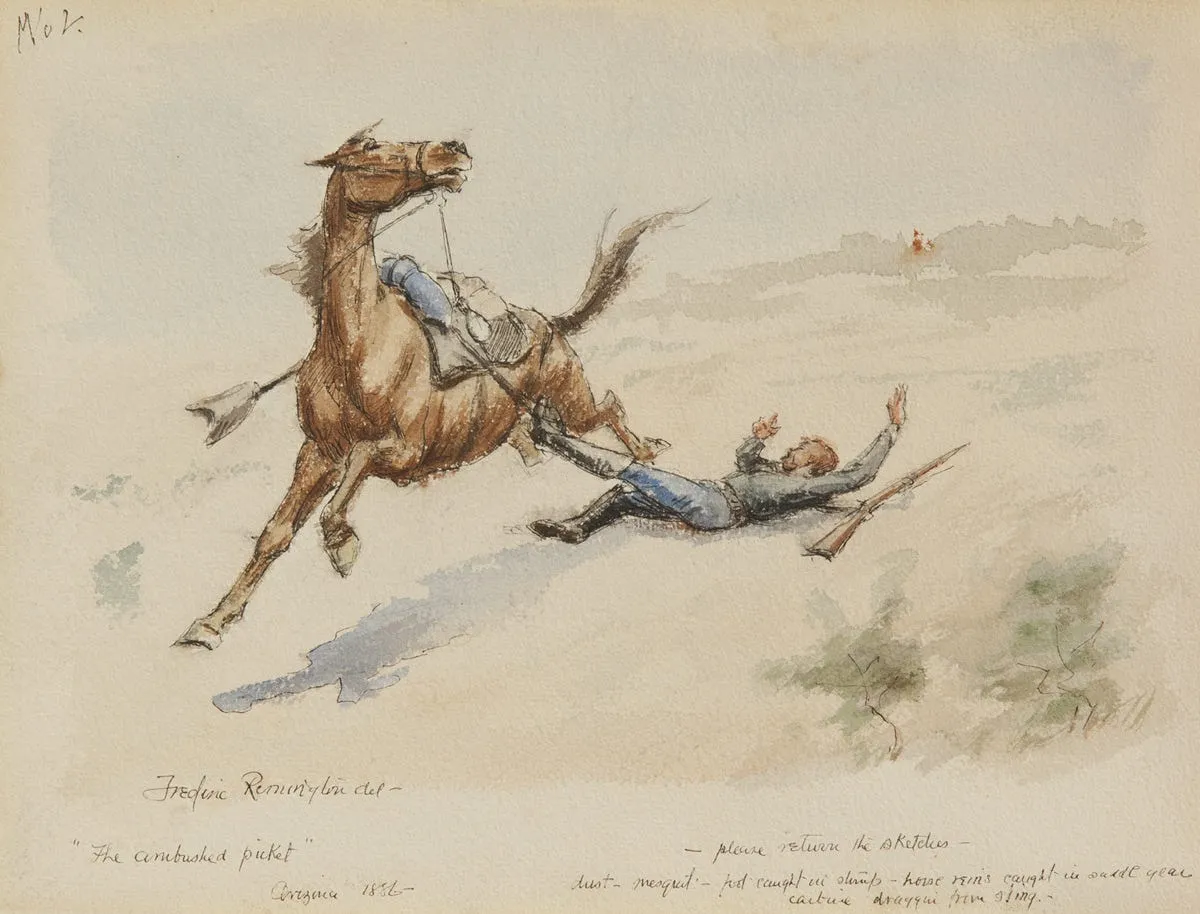
Frederic Remington
We came to Gallup to visit my partner’s old people. His grandma and her sister - Nadine and Jenny - and the whole family have lived here for their entire lives. The culture differs profoundly from anything I’m used to regarding the elderly. My mom’s side of the family is all Europeans who walk me through art museums and talk about what it was like to be occupied by the Nazis. They ask me questions about America that I can’t answer because they’ve been over-serving me wine since noon. On my dad’s side, nice New Englanders with fish-related jobs who hang crosses all over the place and pronounce artistic “autistic.”
I am used to hearing that I am “very autistic.” I am not used to being a lady, to sitting in the shade while men hammer sprinklers into the ground and passing plates and smiling quietly, but this is how I am here. The people in Gallup are different. Time hasn’t stopped, but it’s sure dragging its feet. Jenny and Nadine know everybody, and these days there are fewer and fewer people to know.
“I got all the Navajos,” says Jenny, “and she knows all the oldies, and well that’s everybody.” ‘The Navajos’ are a frequent topic of conversation among the old, who see Gallup as a white town and the indigenous inhabitants as interlopers. “You go to Walmart, and it’s like you’re in a foreign country,” they say, the irony apparently lost on them. Jenny’s hired man, a late middle-aged Navajo who everyone calls “Whoop” attends all family functions. He has an easy laugh and rather less than ten fingers. His job, in brief, includes anything Jenny and her husband can’t do by themselves. On a working ranch with three horses and several hundred cattle, that’s a lot. Rather than the horses favored by older cowboys - including Bruce - Whoop rides an ATV over the washes and scrub out at the ranch.
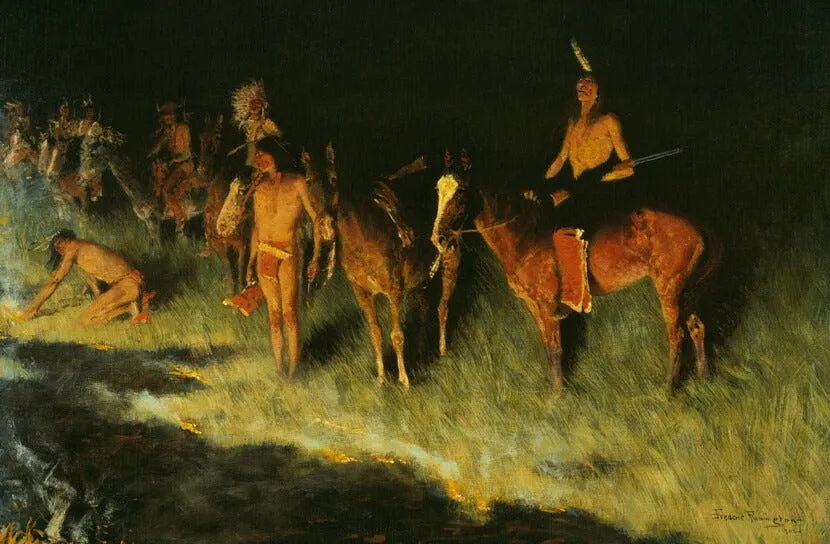
Frederic Remington
Jenny and her husband possess a quantity of land which boggles the mind on paper but in practice is just a whole lot of scrub for cows to roam around in. After the older generation is gone, the land will most likely be sold, subdivided into parcels, the scrub developed into tract housing or lots big enough for maybe one horse, or a skinny cow. The land has been a struggle to keep, the livestock a struggle to keep alive as the years become drier and drier. Only a few horses remained at the time of our visit, most of them unrideable.
I rode a horse named Mikey.
Mikey cost $75 when they bought him, and he is well worth his money, patient and steady and used to a life of herding cows around sandy hillocks, always on the watch for snakes. “If you get a horse, get you an old roper,” said Bruce. “A sound roper, you can’t do better.”
There is also a big ranch house decorated with a lot of unspecifically-sourced indigenous American art. The first time I visited, Jenny showed us a pot her mother-in-law had dug out of a kiva out in Zuni. The pot was about the size of a bag of flour and painted a dusty black, the top decorated with bone and animal hair affixed to a cord of knotted hide and splattered with blood-black resin.
“I used to have it on display out on the mantle, but the Indian girl I had in to clean wouldn’t look at it. She would cover her eyes.” Much was made of this being silly. As a guest, I nodded and looked at the thing, staring and staring, my eyes hungry for something they should not have been allowed to see.
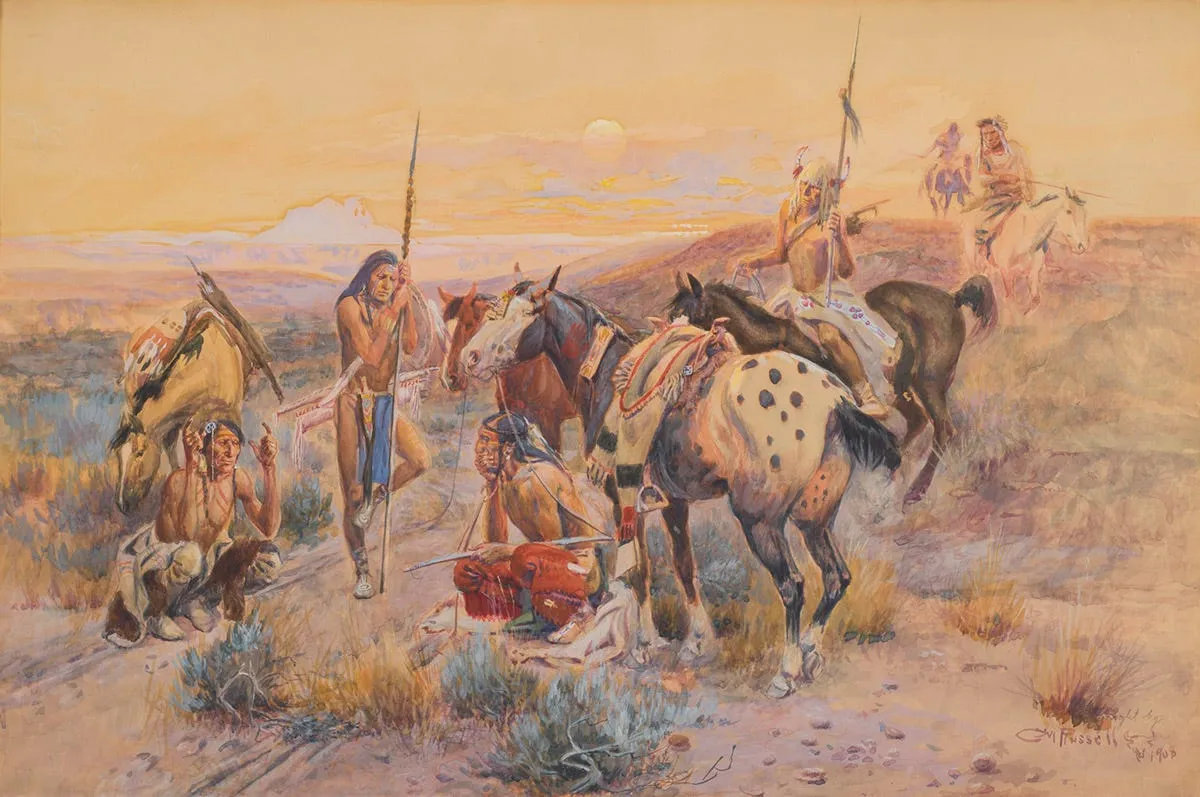
Charles M. Russell
Jenny and her whole family, including her son and grandson and Whoop, came over for hamburgers and hot dogs after a day of work at the ranch. As we sat around the table, the talk turned as it always does to those who have died. It seems that everyone in Gallup dies of misadventure. Car wrecks, sudden illnesses, and suicides abound. Even the horses aren’t safe.
“We had one horse back in the day,” says Jenny’s son, “he died out on the ranch with one of the hands riding him. Heart gave out. The guy let the saddle off him when he went down, so he got to die free.”
Talk turned to Whoop’s ex-girlfriend, whose name nobody could remember, including him. In order, we learned that she was overweight, that she wore too much makeup, that she did a stint in prison during her relationship with the farm hand, and that she and several others were crushed to death by falling rocks behind the Walmart. Her name, it transpired, was Elvera. This struck me as a memorable name, but did not appear as salient to the family as her grooming, her weight, the manner of her death.
Perhaps there are two Gallups: the one I visit, where Jenny and Nadine tell stories of past and present, of a town in decline, and another town which does not see the boundary between McKinley County and the rez as a solid line which people cross.
From an industrial perspective, the most valuable thing about Gallup is that it’s on the way to somewhere else. Although there is some mining and some ranching (less and less, now), these aren’t enough to sustain a city-sized economy. Gallup’s money (what little there is), comes in on the rails.
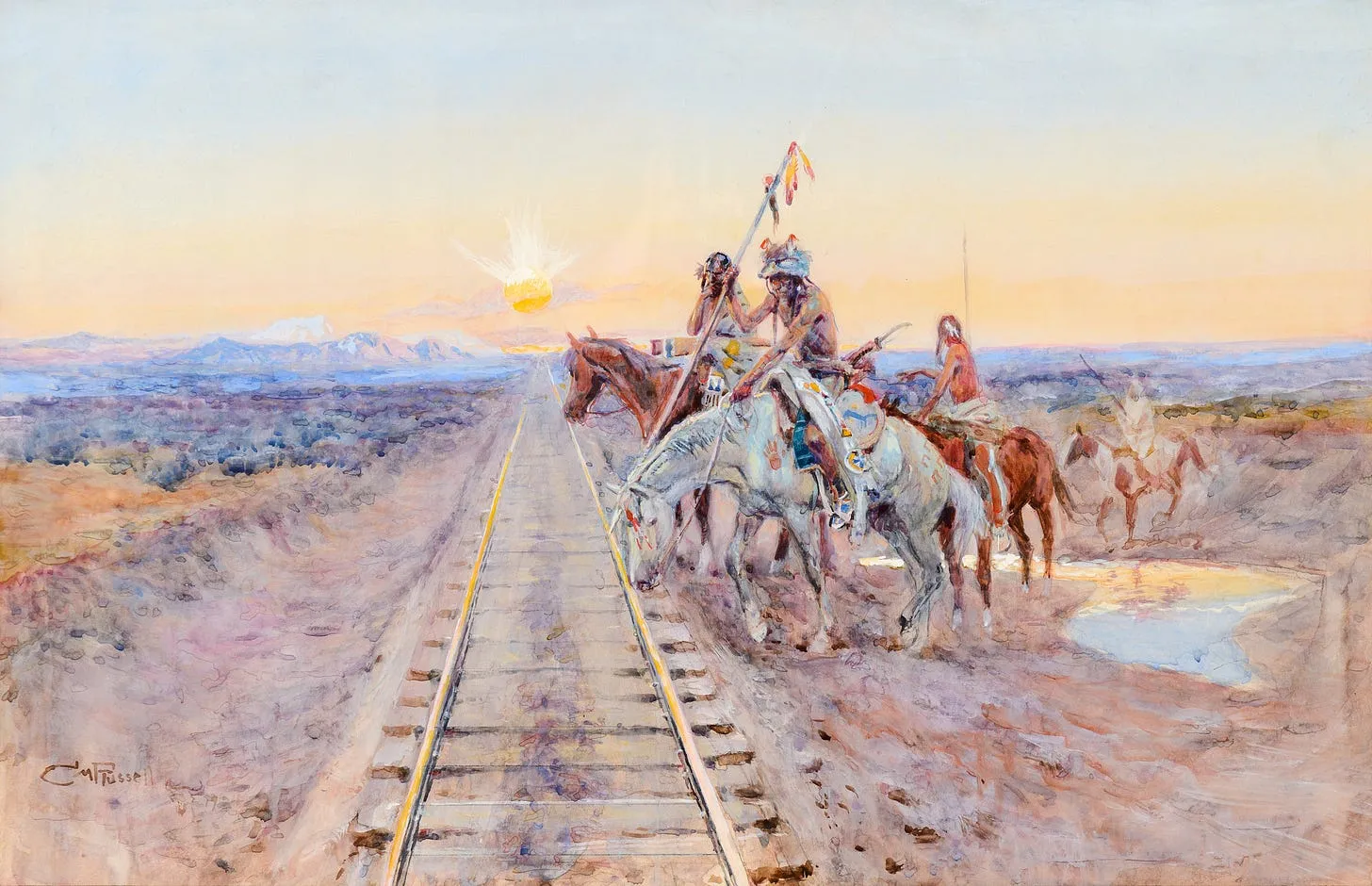
Charles M. Russell
The railroad bisects the town, and unlike most, the rails are frequently used. Anywhere in the valley one can hear the lonely howl of the train at certain times of day like an industrial call to prayer. Toilet paper, gravel, grain, oil, water - the stuff of your life rattles through the desert past crumbling adobe and red rock and sand. Gallup is not close to anything, but all the roads in and out of it are straight and long and flat. You can get there in three hours from Farmington on two lane roads which run off into bluish nothingness. Travel far enough and they end, butting up against other, similar roads which lead into new nothingnesses. Eventually, Gallup appears out of a flatness which was once a mile-deep sea. Looking out across the desert, it is easy to imagine it becoming sea again, the mesas just waiting to be swallowed by dark waters whose currents will caress them into new shapes, the openness prowled by unknowable swimming creatures who remember us not at all.
Much of Gallup looks ageless in this way. The old cemetery doesn’t. Built on pinkish, sandy dirt, it hosts scores of cracked and tipping crypts and canted stones, and many areas are so scrambled it’s hard to distinguish one burial from another. The earliest graves are only from the 1800s. Nadine took us to this graveyard and to the newer, smaller one, pointing out relatives, friends, husbands, children - grown and dead.
“This one was my uncle, married to my aunt. He was a communist - bad, bad man.” No further information was provided. The wind blew plastic flowers across the cemetery, redistributing them in a random, and therefore equitable, way.
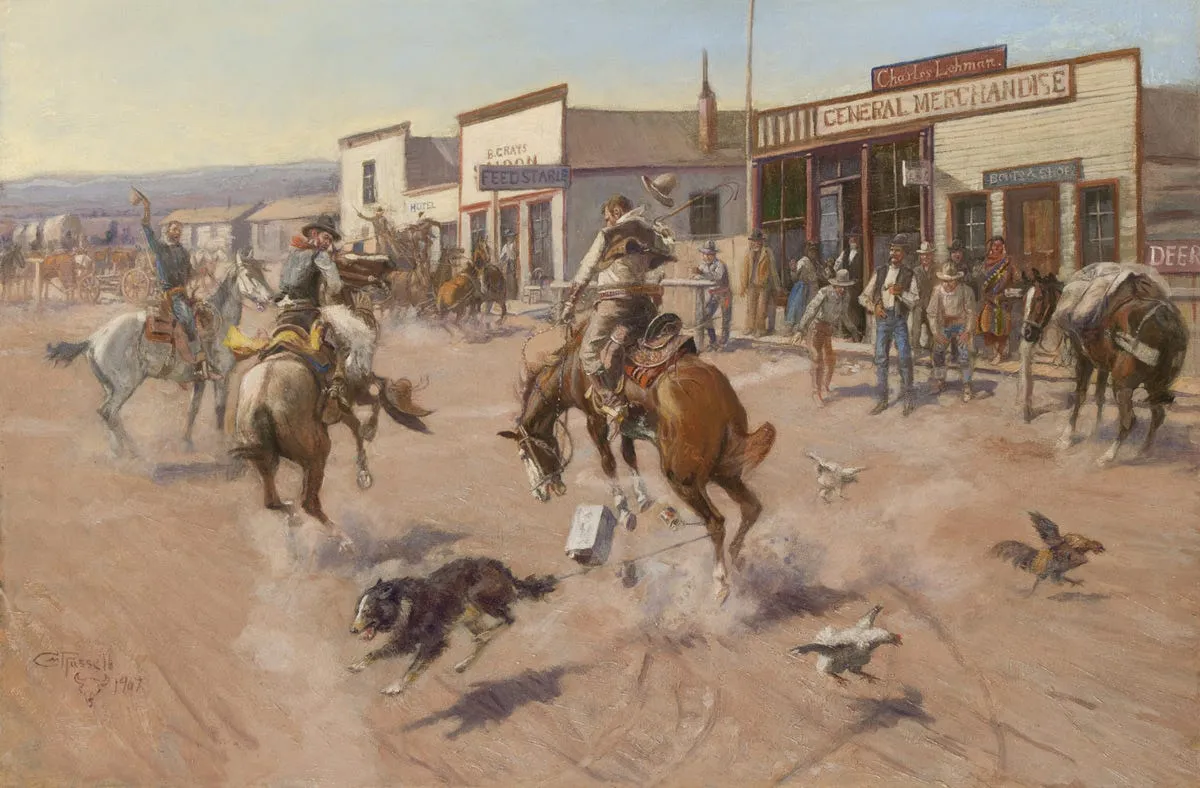
Frederic Remington
At the end of the rodeo, after the winners were announced, the lights went out. The sun had been setting for hours, but by the end the desert dark was total. For a moment, the audience, the competitors, and the animals in their complex bondage of bridles, bucking straps, lassos, ropes, and chains all sat silent. The first firework lit up all our faces, the corresponding crack as loud as if the powder was exploding between my eardrum and my brain. I thought of the horses, held by their riders in the sand pit arena. At the next flash, I looked down to see them standing still, a few head jerks and stamps but nothing major, not like what I would expect. This is part of their job, and it may be the easy part. After each ride, as the bullriders staggered off into the stands, beaten, the rodeo horses sidled calm and graceful around the still-bucking beasts, corralling them back into their stalls as surely as a funnel handles water. The bulls didn’t seem to know what was happening, but went along until they were trapped again, snorting and kicking at the insides of their prison. The horses stayed calm, wet eyes on the crowd. What’s a little firework compared to all that?
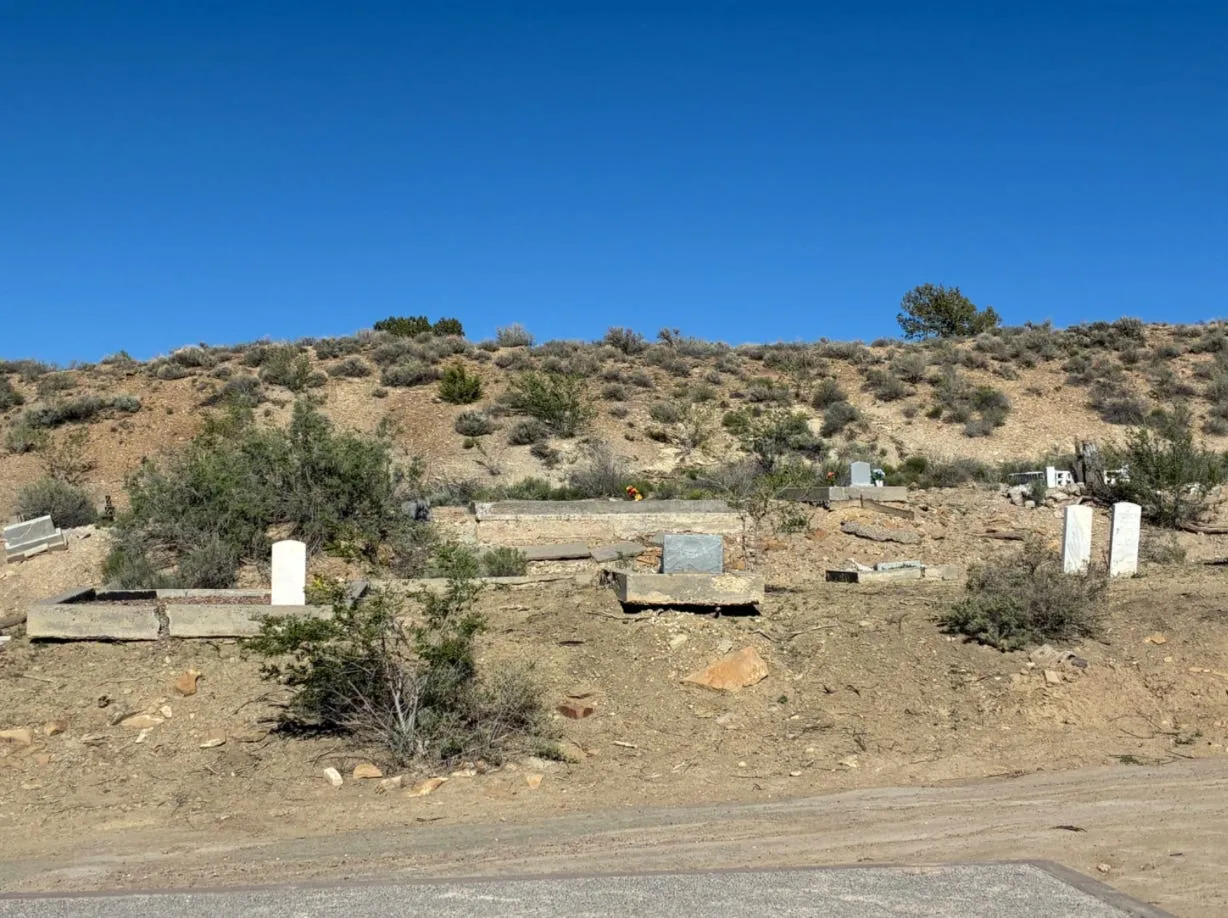
The older cemetery. It all looks about like this.