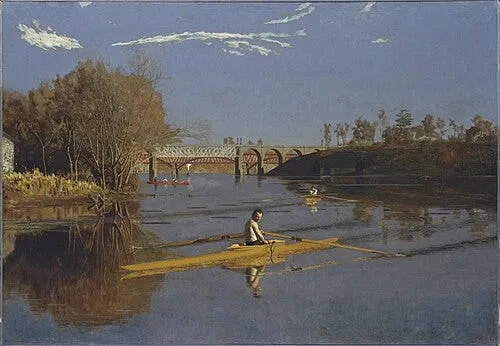
Humans became bipedal millions of years ago. There’s no evidence of anything spherical to kick until around 4000 years ago. This behaviour has to be genetic. There’s much debate over who created soccer first: The Chinese had cuju, played between two teams, a leather ball stuffed with feathers or hemp and a single net. The Japanese, kemari, a game wherein an empty ball was kicked into a collection of trees. Marn Gook, a ball sport from Australia enjoyed by the indigenous population prior to colonialism, was acted without hands. The Europeans enjoyed ball games as a past time, but violent sport was prized above all. Only to the Central American was ball sport king and was regularly enjoyed across the continent for at least 3000 years prior to Spanish fleets arrival. Wherever the time machine plonks you down in prehistory, you will likely find someone, somewhere, kicking a ball into something, and even more people watching, emotionally invested. The widespread delight of soccer today leads you to believe the prehistoric reaction to proto-soccer to be the same revelry. Delighted with skill! Enthralled by competition! Or repulsed…?
It’s hot in Washington, DC. It’s 92 degrees. It’s June 5th, National Donut Day. There’s two ways to celebrate the holiday. 1 - giving as many donuts as possible to those hungry and unhoused, spreading the word of community and almsgivings, ensuring the neighbour need not starve or, 2 - using donuts as a means of testing human intestinal capacity. I’m in the shade, a member of a two-dozen-man crowd. We’re all geared up to watch. I’m in the shade. We’re standing on the World War One monument, a few blocks north of Donald Trump. It is the National Donut Day Donut Eating Competition.
James Webb, an Australian who lives in America for about half the year, was champion the year prior and he’s returned to defend the title - last year, this manifested in eating 64 Bakemark donuts in an eight minute window, or at least 12,000 calories of donut. The average adult man needs 2500 calories a day to maintain his weight, give or take a gram of protein for every pound he packs, and a quarter of that grammage in fibre. He needs a variety of vitamins (micro nutrients) to keep the organs functional. 190 calories, 100 from fat, 3g of protein, almost none of fiber, 22g of carbohydrates in an Original Glazed Krispy Kreme Donut, with 6g of calcium, 4g of iron and 2g of vit C, to get an idea.
There’s a handful of girls in these adorable, but I can only imagine really uncomfortable, corduroy outfits made to mimic the apparel of the original Donut Lassie. Though the title Donut Lassie may conjure up images of a Scottish woman driving in circles, it was really a woman who was sent into battle into WWI (I’m dead serious) in a corduroy skirt and blazer with a tin hat on her head, which she would remove and then fry donuts in for hungry soldiers before they performed wartime heroicisms. Many elements of war are ‘hell’ but few think of the consumption of food from a hat.
Webb, our defending champion, fell into competitive eating. En route to a winery hours from his Sydney home, his girlfriend requested they stop for a bite. Prior to this, he was always the foodie on site, he was always the one to look up restaurants of the places they were going, to look forward to meals. They stopped at a bar hosting an eating competition, he enters as a joke and wins. “Turns out, it was Australia’s biggest hamburger. I ate it without even trying. It was like a $500 prize. I took the prize money and I went to the fudge factory and I bought fudge. It was just a joke. But that’s where it all started. Competitive eaters started messaging me. I made it onto national news. That’s when I discovered the world of competitive eating. People started messaging me saying, ‘you need to do this food challenge, that food challenge.’ So I started doing it as just a pure joke. Like, honestly, just the biggest joke.”
Do you think competitive eating is a sport?
“This is a competition. I’m very strict on my definition of sport,” a spectator offered.
“That’s a good question,” another answered. “…It’s physical.”
“I can’t say,” a friend answered that evening. “I mean, it’s a show, for sure.”
“Yes, absolutely,” Richard Shea, the head honcho of MLE (Major League Eating) tells me. “It’s physical activity governed by a set of rules.” The way it’s written makes it seem like Shea is defensive, but there’s actually no defensiveness in his voice. Matter-of-fact, if anything.
There’s four major bodies that govern the world of sport, and within them subsections of smaller associations or federations - the Associations of Summer and Winter Olympics, the Association of IOC Recognised International Sports Federations (ARSIF), Alliance of Independent Recognized Members of Sport (AIMS). The Olympic Associations oversee sports played during the Olympics, AIMS represents sports not yet recognized by the Olympics (darts, miniature golf, bodybuilding), ARSIF represents sports recognized by the Olympics but not performed (American football, chess, orienteering) in the Olympics. The Olympic Committee has, through cultural legitimacy, positioned itself as the final judge of what is and isn’t a sport - in 2024, Breakdancing was, to much criticism and ridicule (particularly when an Australian competitor did this), accepted as a competing sport in the 2024 Olympics, while squash, whose governing body has been vying for acceptance for decades, has not. The International Olympic Committee’s (IOC) Agenda 2020 mentions declining youth viewership as part of the motivation for their move to add surfing, skateboarding and sport climbing and Thomas Bach, an IOC official cited ‘youth appeal’ as a reason to add breakdancing - which begs the question where the IOC is getting their information from?
Founded in 1894, it’s the world’s longest lasting sporting governing body. The IOC is the cultural judge over what is and isn’t considered a sport, after wedging itself as the governing body of all things athletic since its founding in 1896 and continued growth. This growth has firmly established the Olympics as the world’s biggest athletic event and with it, an aire of prestige to govern all sporting federations.
Does it matter if this is a sport, a competition, a spectacle? Does one add more legitimacy, or is it just to clarify reality?
“It’s a physical activity governed by a set of rules,” Shea continues. “I think that’s the definition of a sport. The competitors, themselves, make it a sport.” He answered this quick and confident, there was neither memorization or defensiveness in the tone. “If you saw the fight today between Cameron and Max, for second place, that’s an athletic endeavour. I mean, they’re pushing themselves. It’s like a runner would, you know? They study, they try to improve, they get on the road, and they go to different events.”
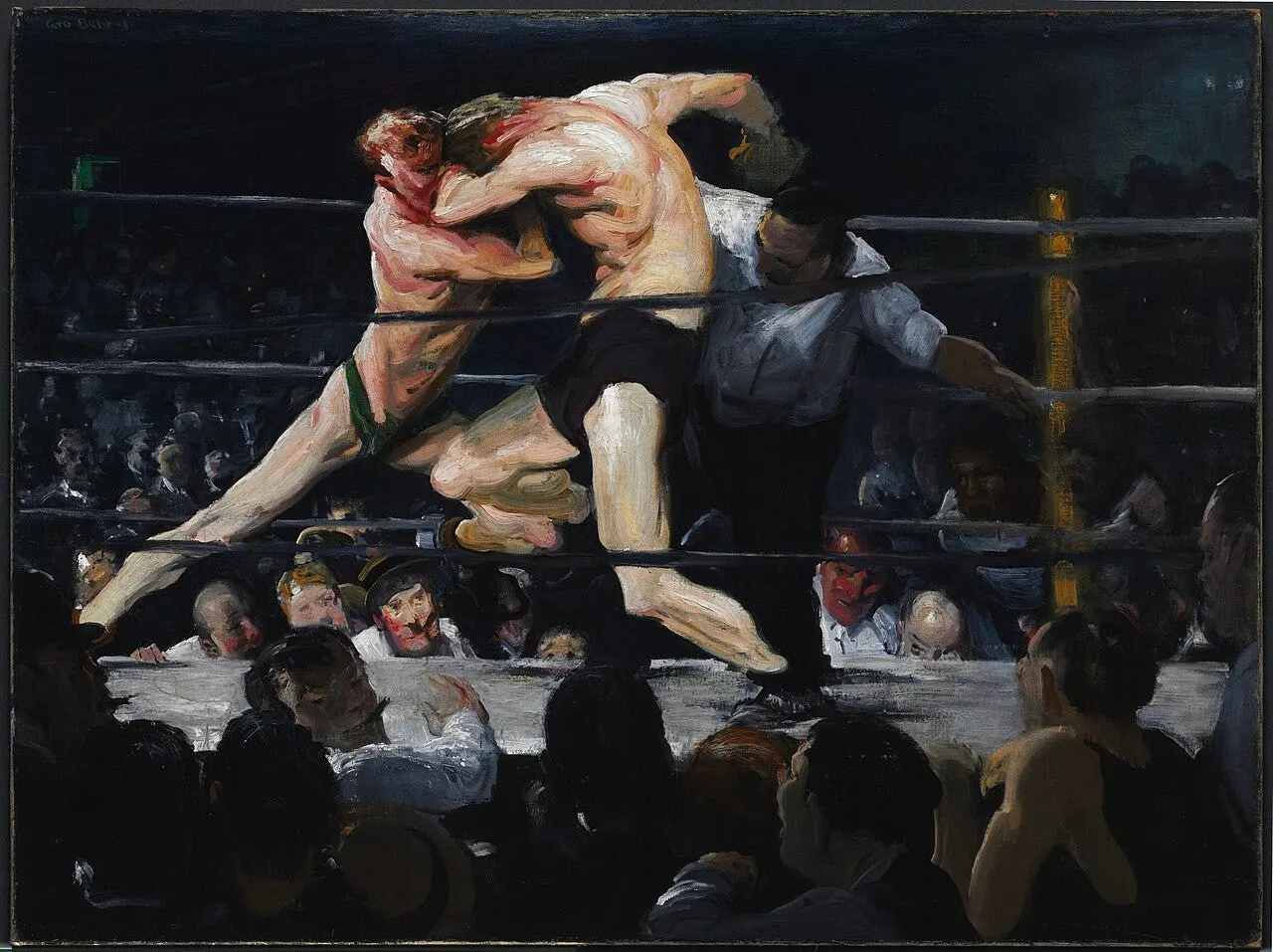
George Bellows, Stag at Sharkey's, 1909
Webb gains 25kg, just over 55lbs, every season, then loses it all before the beginning of the next. During these pre-season rest periods, he eats 1000 calories a day, walks to the gym twice every day to train and slim back down. During the season, he fasts between competitions and challenges.
By his own metric, the muscles in his abdomen have become distorted from the stomach extending. His fellow competitors are not so friendly and are types that typically keep to themselves. He is constantly on the road. He does an extensive check up back home in Australia to ensure he is entirely healthy. “I’m guessing it’s no different to an MMA fighter, a boxer, football player. They put their body through absolute hell to perform on game day, right?”
“Okay, look at a soccer player, right?” Webb tells me when I asked him the obvious question we all thought when introduced to competitive eating: is this healthy? “Like, look at LeBron James. LeBron got famous for putting up a photo of his feet, right? His feet are absolutely buckled from being in basketball shoes every day, you know? Look at a rugby player, they get cauliflower-y. MMA fightings. They get cauliflower ear, they’ve got broken noses, buckled faces, right? Competitive eating, your stomach, cops it.”
It’s well documented that athletic fighters will avoid food and water for 24-48 hours prior to weigh-ins to fit into certain weight classes. Boxers not only have cauliflower ears but are kind of just a walking collection of the concussed and brain damaged, same with hockey and football players. Baseball players, particularly pitchers, so commonly tear the UCL in the elbow that many players get preventative Tommy John surgery on it. The hard jumping and extreme flexibility demanded in gymnastics leads to premature arthritis and spinal fractures. The jumping in basketball and volleyball lead to tears in the tendons of the lower body, particularly the knees. The shoulders of tennis players and swimmers are well-known to be torn and sensitive at demonstrably younger ages than non-athletes. Beyond this, the stress of competition, the lack of sleep, the brevity and temporaneous nature of the career is by no means healthy. There touts the belief that because athletes rely on the body for work, they must be the healthiest who walk the planet, but the opposite is true. They are pushing body and mind to its furthest extent, no different than competitive eaters, far away from what any medical professional would deem ‘ideal health.’
“I think it’s both pageantry and sports,” Shea is no stranger to pageantry. Him and brother George run a PR agency, and together they worked with Nathan’s Famous International Hot Dog Eating Contest as part of their public relations efforts until the event slowly fell under the control of Major League Eating entirely.
Nathan’s Famous International Hot Dog Eating Contest is arguably the world’s best known, easily the world’s most watched (it’s aired annually on ESPN) eating competition. Starting in 1916, Nathan’s Famous International Hot Dog Eating Contest began with a group of immigrants ambitious to demonstrate their patriotism through eating something undeniably American. Jim Mullen, an immigrant from Ireland, won with a then-record of 13 hotdogs. This grew over the years into a massive display of show and pomp, with competitors all over the world (particularly popular with the Japanese, whose Takeru “Tsunami” Kobayashi bested all American contestants for six years before he was dethroned in 2007 by Joey Chestnut - a titan in the world of competitive eating, and, by most metrics, the best to ever eat a lot of food really fast).
“If you look at professional sports today,” Shea reasons, “like the NBA or the NFL, you know, decades ago, you would go to a basketball game, they’d blow the whistle, they’d play basketball, and that would be it. Now they’re shooting all kinds of stuff into the stands, shirts, and there’s all kinds of entertainment at every break, music, and there’s stadium cams. They sort of loaded the pageantry into these professional sports that everyone accepts as sports and they’re not. Whatever, the chicanery. We started with the pageantry. You know, because we’re born out of Coney Island, which is pageantry.”
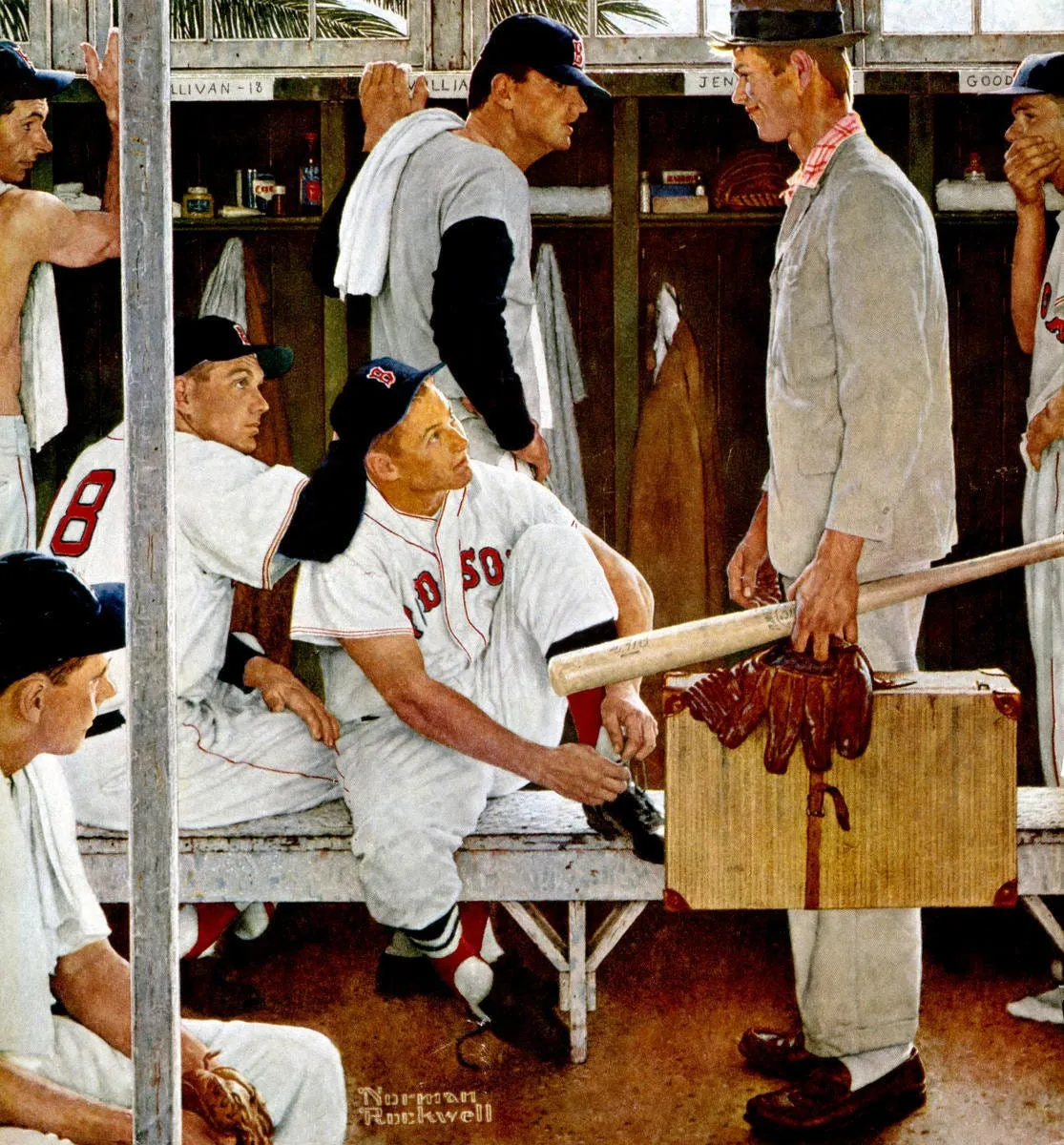
Norman Rockwell, The Rookie (Red Sox Locker Room), 1957
There’s billions of views for competitive eaters online, even if the following itself isn’t massive. Shea is regularly asked to attend events with his barrage of athletes to raise press. This year’s Salvation Army and BakeMark, the nation’s largest supplier of wholesale baking ingredients, hosted the Donut Eating Festival and requested MLE attendance. A Strawberry festival will have major league eaters in attendance, the city of Buffalo’s annual Buffalo Wing fair, too. A number of casinos have extended invites to MLE to bring their athletes. This is partially why Nathan’s Famous Hot Dogs stays in mind - we immediately associate hot dog eating competitions, and perhaps even some of the more gaudy elements of the nation’s birthday, with Nathan’s Famous.
Webb’s YouTube channel viewers are a combination of different people: casual viewers who have, for whatever reason the algorithm decides, enjoyment in food or eating content. Foodies. Chefs. Mukbang surveyors. The type who like shock value content come into the equation.
“I get recovering people from anorexia and stuff like that,” Webb’s viewers are not just the remainers of the Fear Factor type. “They tell themselves eating is bad. But I get people saying ‘listen, I watch your videos and you help me get my food in.’ I’ve dealt with people that have eating disorders. I’ve spoken with people, like, given motivational talks to people that are suffering from mental illness. I’ve been contacted by people that have had stomach surgeries, that can’t eat food. So they eat vicariously through me.” He’s also been a favorite for body builders like himself who are in a cutting period, who also want someone to eat vicariously through.
“I actually got invited to this kid’s birthday party. His mom reached out to me and said, hey, listen, I know this is a really random request, but how do I get you to come to my son’s birthday party? Anyway, look, I didn’t ask for more. I wanted to go. I went there, played at the arcade for an hour with this kid. We went to this burger shop after the arcade, and this kid, he’s autistic. I never really had anything to do with anyone with autism or anyone on the spectrum, right? And I didn’t know what to expect. I sat next to this kid, they ordered me a burger and fries. He had a burger and fries. We started eating like nothing. And then, again, not knowing about autism and stuff, I didn’t know that, like, at the click of a finger, these autistic kids, they can’t regulate their emotions, and they go crazy. He started having a bit of a tantrum. We’re eating our burgers and it was a pure reflex to try and make him laugh. I picked up a bunch of fries and shoved them in my mouth. The whole room went quiet. The kid started laughing and continued eating. I’m like, okay, cool, whatever, awesome. Anyways, we finished our meal. I gave him a high five. I’m like, ‘all right, dude, happy birthday.’ The whole family started crying. I was like, oh no, have I offended you, what have I done? The mum was crying because her son hadn’t eaten a complete meal in years. The brother — he used to watch my videos, and they used to put it on the TV to try and get this kid to eat. Because watching me eat would be the only thing to calm him down to actually eat his food… He can’t regulate his emotions to physically sit there and eat his meal. Anyway, so then this escalated, the mom went to school on the Monday, told the whole freaking school, I got the principal contacting me saying, ‘hey, can you come to the school and give a talk to our students?’ Turns out, now they play my videos at lunchtime. So the autistic kids can actually eat their meal.”
The prioritization of YouTube and gimmickry may insight further debate that the MLE is less-than-legitimate, more circus than sport - but can the same not be said for the MLB, the NBA, NFL, NHL, La Liga, Serie A? Any major sporting body? There is some element of pageantry with any sport that has a cheerleading team, an extravagant halftime show, prizes flying into the audience’s hand (arguably part of the appeal of baseball to a 10-year-old is the chance of catching a homer) but even beyond that - the very essence of all sport is to keep viewers watching. The more exciting, emotional, shocking, a sport, the more viewers. BakeMark invites the MLE to come, but broadcasters will pay major league sporting federations for the rights to broadcast, thus bringing in money from advertisers. The more we watch, the more ticket prices are, and beyond that, to an infinitely greater degree, the more advertising will pay for the visual real estate to viewers looking. Basketball, baseball, football, etc, are just the treats we get for watching the commercials play. Even if you pay-per-view, there still exists the Pepsi labels painted to the side of the pitch’s walls, on the apparel of the athlete themselves, there are still breaks for commercials, and commentators will name their sponsors and advertisers.
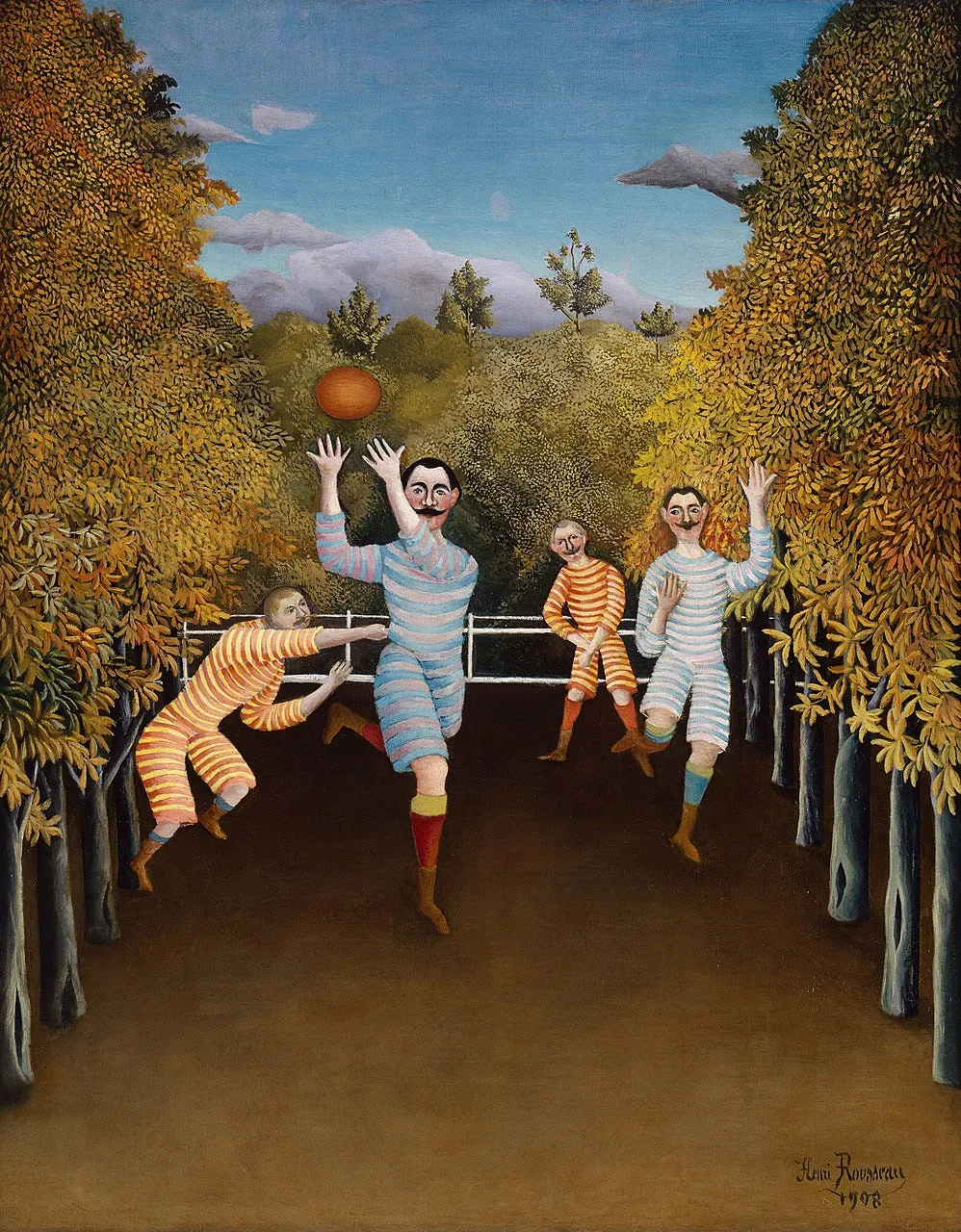
Henri Rousseau, The Football Players, 1908
If established, respected and accepted ‘sports’ all are primarily concerned with viewership and use athleticism, and by extension, showmanship, to attract these viewers, what is the difference between Joey Chestnut, spitting and sweating, forcing food down his throat, consuming 76 hotdogs in 10 minutes against a lineup of competitors and and Connor McGregor, crazed and furious, besting José Aldo in 13 seconds? Is part of the reason crowds flocked to watch the Irishman in his prime not for his taunts, his showmanship, his gimmicks?
I have two thoughts that remain: first, does the eater feel that deeply competitive emotion that the Jordans, the Agassis, the Zidanes are known for? I watch a competitive eating match and I do not feel any competitive drive, I have no contestant I’m rooting for in particular, but I also have none of this sensation when I’m watching any sport I’m unfamiliar with. There’s tens of thousands of fans of Chesnut or Kobayashi who have vested interest in the sport and undeniably feel that profound wave of satisfaction when their preferred player dominates. Though, when I watch it, and perhaps most, I feel more interested in the shock. I am more impressed with the ability to consume 12,000 calories in 10 minutes. I am more curious about what happens to the body after. But all of these might come because of general lack of knowledge around competitive eating.
My second thought is: does the definition of sport and what we recognize as sport even matter?
“To be recognised by the IOC, a sport must first of all be governed by an International Federation (IF). This is required in order to conform to the Rules of the Olympic Charter, the World Anti-Doping Code as well as the Olympic Movement Code on the Prevention of Manipulation of Competitions.” says the International Olympic Committee on accepting a sport into its ranks. There’s no further definition of what is accepted as an IF that includes athleticism, competitive nature, players. The IOC will accept any sport into its collection that has a body governing it on a national level, which Major League Eating has.
Hypothetically, competitive eating could be recognized by the Olympics as a sport under this definition. So how are you going to debate it now? Do you think you have more legislation to define a sport than The Olympics?
Stranger activities have been defined as sport. Bridge (the card game your grandmother is really hype about) is considered sport by Olympic standards. Orienteering, a sport in which competitors are given a map and a compass and instructed to navigate unfamiliar areas from point A to point B as fast as possible, or “get lost in the middle of the woods and find your way out as fast as possible against another person,” is an IOC-recognized sport. Tug-of-war is considered a sport by Olympic standards.
The undeniable reason we accept the laundry list of recognized sports as sports is because of cultural acceptance. There are countless Americans, who, unfamiliar with cricket, will mock it and regard it as play. Same with sumo. Of course, neither the Indian nor the Japanese will accept these comments. Soccer, the world’s most played and beloved sport, is generally ignored by the American. The cultural acceptance of certain sports - baseball, for example - came with successful marketing efforts. FDR encouraged the MLB to continue airing throughout the Second World War to keep morale amongst home-bound Americans high. MLB titans, Joe DiMaggio and Ted Williams, had just returned from the fight to play ball. These were real life, American heroes who had gone abroad to fight the Nazis, come back to American soil to hit a home run. Jackie Robinson, though not the first Black baseball player, was credited as desegregating sport, played at the same time. It was a marketing dream to have both a Black player in a segregated America and two war heroes play ball - at the same time! Baseball’s popularity skyrocketed and was the most popular sport in America. The NBA’s popularity rose with the intense and widely-reported rivalry between Bird and Magic, and was further solidified with Michael Jordan, largely praised in public media on as the best athlete to ever live. The NFL rose in popularity in the mid 60’s, coincidentally when the AFL-NFL merger made major national news.
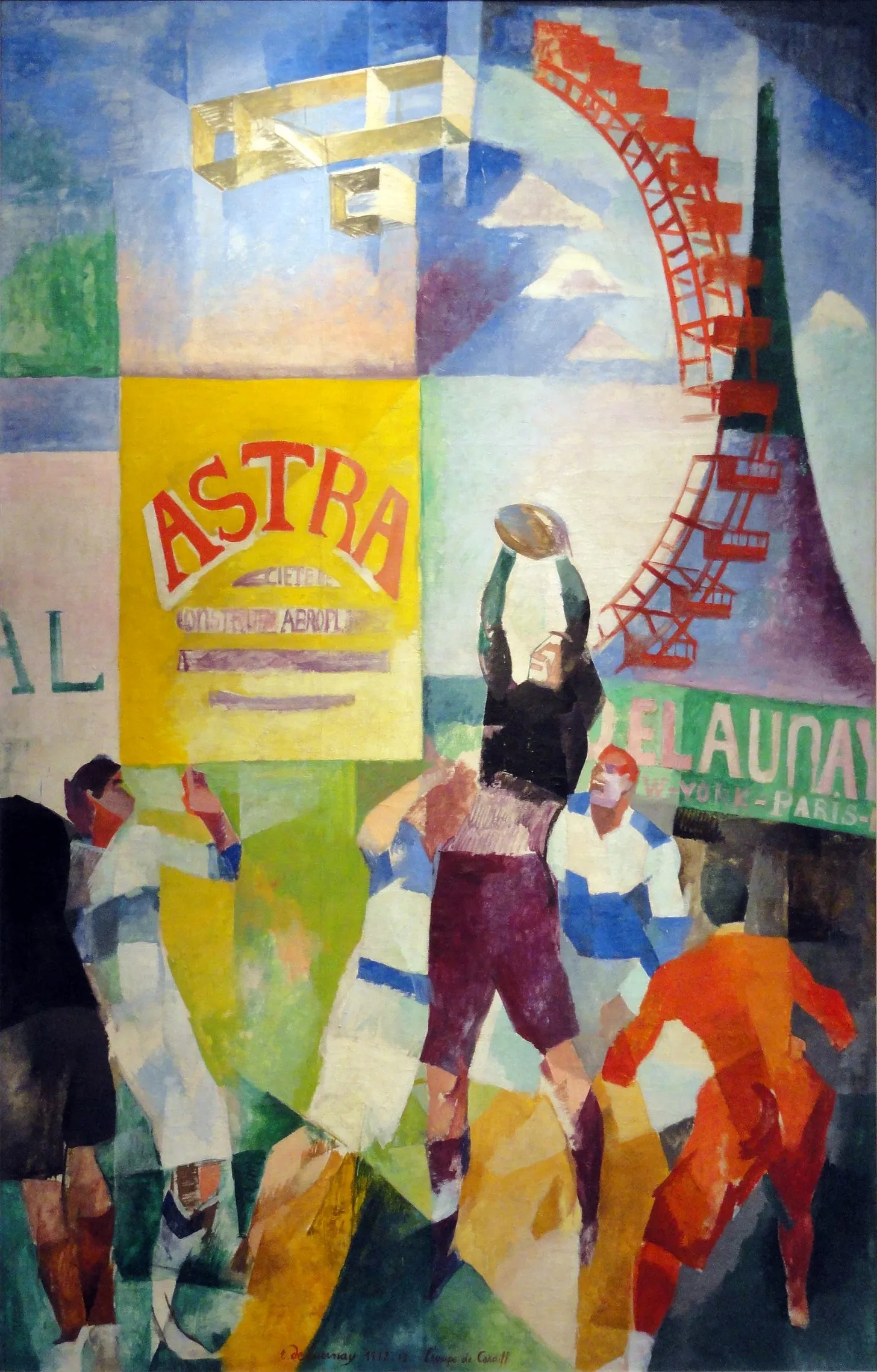
Robert Delaunay, L'Équipe de Cardiff, 1912-13
None of the most widely watched sports in America came without advertising and marketing to push it into public knowledge, and none of them maintain that popularity without continued marketing.
But does it matter, what is considered sport? One can argue the acceptance of a certain sport is a reflection of the values of people. The Canadian likes hockey because they are a cold-enduring/loving people (though, hockey is violent and aggressive, and Canadians are stereotyped for their kind and mild demeanours). The American likes football because it’s violent and stupid (though the rules to American football are not obvious to anyone watching for the first time, while something like soccer is straightforward). The Chinese like table tennis because it’s affordable and tables can fit anywhere (though I have my doubts that the table can fit in the widely-documented cramped apartments and limited open spaces that evade Chinese metropolises). I would argue, besides marketing, the success of a sport in a country and its acceptance is more the result of climate (Russia, Canada, Finland and Norway all demonstrate favoritism towards hockey, soccer is beloved in the warmer climates of Africa, Southern Europe and Central/South America) than cultural personality.
Another element to the acceptance of a sport is the way it’s discussed. Baseball games were broadcasted on the radio for decades prior to the invention and popularization of the television and were recited in serious, detailed terms. All sports are commented on as they’re played by knowledgeable narrators. This is yet to exist in the world of Major League Eating.
After last year’s dominating performance at the National Donut Day Donut Eating Contest, James Webb is back to defend his former title. Last year, he inhaled 64 donuts in an eight minute window, besting Nick Wehry and Noah Romoff in a clear victory. Besides Webb, there are no repeat contenders to challenge the title.
Twelve competitors line up and before them lay a plate of five donuts. Once these are finished, a second plate of five donuts will be brought to them. They are given unlimited water in plastic cups, which many use to dunk the donut in so they do not have to stop to drink (thus losing time).
From the first thirty seconds, it’s clear to see that Webb has a hold on his title. His technique is to dip the donut in water, compress it to remove air, and swallow it in as few bites as possible. Other competitors will switch between biting, chewing, and sipping and lose stamina and their edge, regardless of satiation.
Other players chew in exaggerated, full chomps, while Webb is actually quite delicate and quick with his movements. Others will hold their head up to elongate the esophagus, shove the whole donut into their mouth and press with the hand to fully engulf it with wide, exaggerated movements, while Webb is much more precise. He holds his cup of juice with his spare hand and occasionally sips.
By the halfway mark, five minutes deep, about half of the competitors have slowed down. Remarkably, Webb hasn’t slowed at all, pacing himself at the same speed he had from the first thirty seconds.
With three minutes remaining, all but three are exhausted and have slowed eating almost entirely.
Webb starts to slow a bit, but is still moving and eating at a remarkable speed. Webb is in the lead, Max Stanford and Cameron Meade are tied for second.
With thirty seconds remaining, almost everyone has stopped eating or slowed tremendously with the exception of Webb, Stanford and Meade, who power through with an aggressive fury. Stanford is moving at incredible speed and is throwing his head back with the finish of each donut. In the last fifteen seconds, Stanford and Meade push themselves and move as much as they can, holding it in their mouths to slowly swallow. Webb has defended his title for another year, with Stanford in second and Meade in third - at 63, 56 and 50 donuts eaten in ten minutes, respectively.
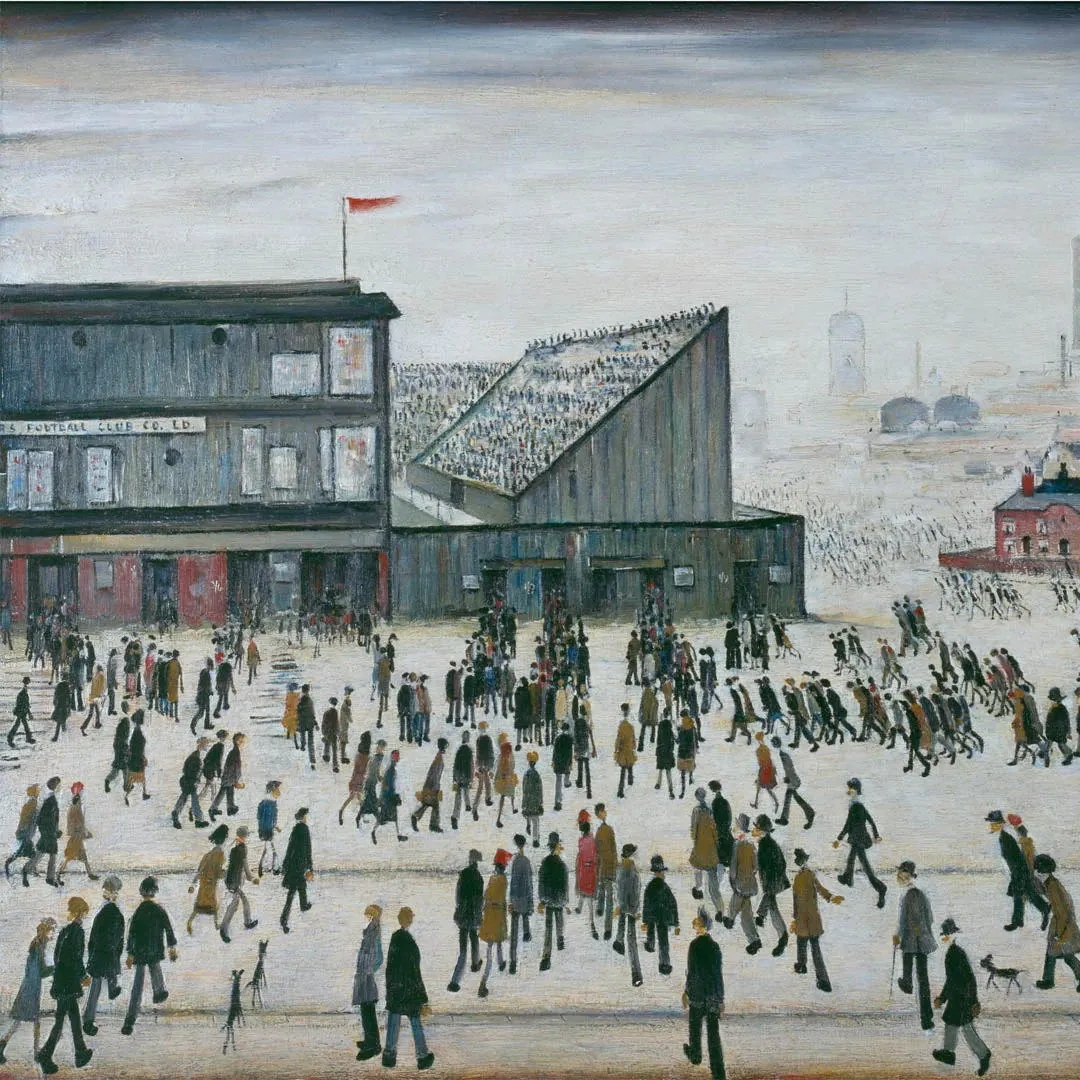
L. S. Lowry, Going to the Match, 1953